The five failure patterns behind most abandoned AI pilots, and the cheap checks that catch each one before you have spent a budget finding out.
·4 min read
Small businesses do not usually fail at AI because the technology was not good
enough. They fail earlier, in the choosing, and by the time anyone notices, the
budget is gone and the conclusion drawn is “AI does not work for us.”
These are the five patterns we see most, with the check that catches each one
before it costs anything.
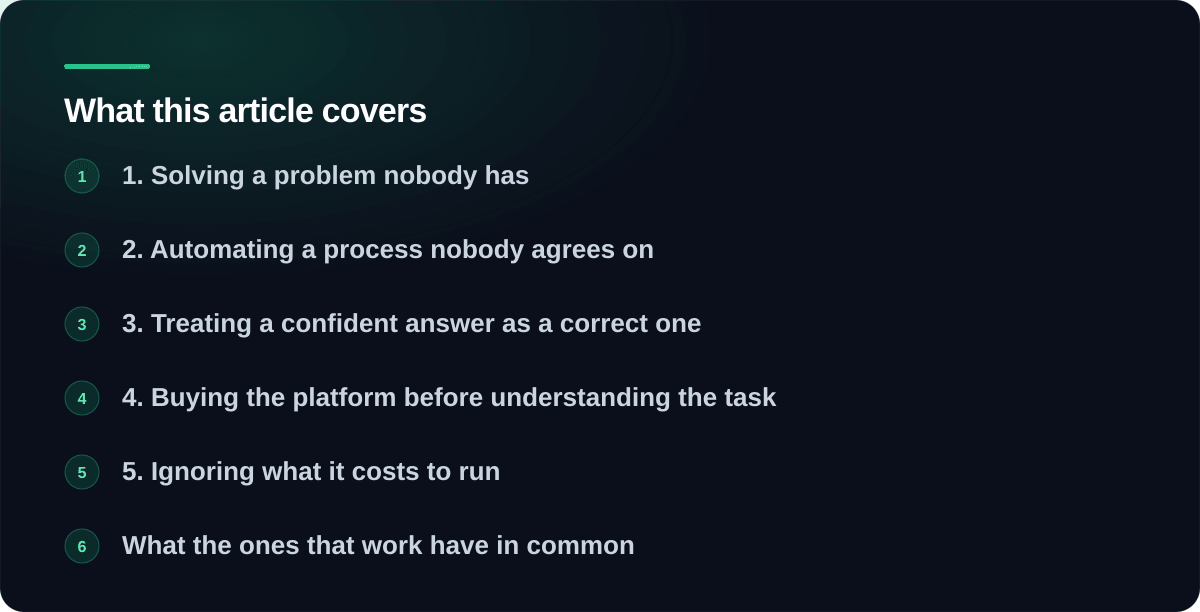
1. Solving a problem nobody has
The project starts because AI is on the agenda, not because a specific task is
painful. So somebody picks something visible and plausible, usually a chatbot on
the website, and builds it.
Six months later it has answered forty questions, thirty of which were “what are
your hours.”
The check: name the person whose week gets shorter, and by how many hours.
If you cannot, the project has no owner and no measure, and it will be judged on
novelty, which wears off.
2. Automating a process nobody agrees on
AI is very good at doing a task consistently. It is useless when three people do
the task three different ways and each believes theirs is correct.
Attempting to automate in that situation surfaces the disagreement, which is
genuinely valuable, but it surfaces it halfway through a build rather than at
the start.
The check: write down the current process in ten steps and have two people
who do it confirm it is right. If they cannot agree, that is the project, and it
does not need AI.
3. Treating a confident answer as a correct one
Language models produce fluent text regardless of whether they know the answer.
For summarising a document that fluency is fine. For quoting a price, citing a
policy or answering a customer’s legal question, fluency without grounding is a
liability with good grammar.
This is the failure that damages trust fastest, because the first wrong answer
that reaches a customer ends the pilot.
The check: for every output, ask what happens if it is confidently wrong and
nobody notices for a week. If the answer is expensive, the system needs
citations back to source documents and a human approving anything outward
facing. If the answer is “nothing much,” proceed cheaply.
4. Buying the platform before understanding the task
The market is full of platforms that do everything, priced per seat, configured
over months. They make sense for organisations with a dedicated team to run
them. For a business of twelve people they are a large recurring cost attached
to a capability nobody has yet proven they need.
The reverse also happens: a business builds custom infrastructure for something
an existing tool already does well.
The check: do the task manually with an off-the-shelf assistant for two
weeks first. Paste the documents in by hand. It is tedious and it answers the
only question that matters, which is whether the output is good enough to act
on. Build or buy is a
different decision once you know that.
5. Ignoring what it costs to run
Pilots are cheap because ten people use them occasionally. Costs arrive at
rollout, and they are usually not the model calls. They are the embedding and
re-embedding of documents, the storage, the retries, and the person who now owns
keeping it working.
We wrote out the actual arithmetic in what a document AI system costs to
run, because the gap between a pilot bill and a
production bill surprises people.
The check: multiply your pilot usage by realistic adoption and add a line
for the human who maintains it. If the total is uncomfortable, the project is
not viable at scale and it is better to know now.
What the ones that work have in common
They are boring, narrow and measurable:
One task, not a capability. “Draft the first version of the site report”
rather than “AI for operations.”
A person who wanted it, who was consulted, and who will use it daily.
A quality bar defined in advance. Good enough to edit, not good enough to
send. Those are different systems with different costs.
A clear fallback. When the model is unavailable or unsure, the work still
gets done the old way rather than stopping.
A number, checked at ninety days. Hours saved, backlog cleared, response
time. If nobody committed to a number, nobody can call it a success or a
failure, so it will drift.
The honest first step
Pick the most repetitive text-shaped task in the business. Not the most
strategic one, the most repetitive. Do it with an assistant manually for two
weeks and keep notes on where it was wrong.
That fortnight costs almost nothing and tells you more than a proposal will. It
also quite often ends with the finding that the task should be eliminated rather
than automated, which is a better outcome than either building or buying.
If you want a straight read on whether a specific task is worth automating,
describe the task and who does it now. Sometimes the answer is that
software is not the fix, and that is worth hearing before you spend.
One email when something new goes up, roughly twice a month. Plain
writing on what software costs and what is worth building. No sequences,
no sales calls, and one click to leave.
Tell us what the problem is. You will get an honest read on whether it is worth building, what it would take, and roughly what it would cost. No pitch deck, no pressure.
Six things: marketing websites, web applications, internal tools, AI systems, AI agents and MCP servers, and database work. Most projects touch two or three of them rather than sitting neatly in one.
Yes. Marketing sites, landing pages and content platforms, built on modern static tooling rather than page builders. They load in under a second and have the technical SEO groundwork done properly.
Yes. Customer portals, dashboards, booking systems and SaaS products. The kind where users log in, data persists and money changes hands, so it has to be right.
Software your staff use rather than your customers. A dashboard pulling numbers from systems that do not talk to each other, a job tracker matching how you actually work, or a scheduled job replacing a report someone assembles by hand every Monday.
Yes, and we will tell you when it is the wrong tool. Retrieval over your own documents, support assistants, document extraction and classification, all built with evaluation and guardrails from the start.
MCP is the standard that lets AI assistants reach your real systems instead of guessing. We build MCP servers that expose your data and tools to Claude and other clients, and agents that carry out multi-step work with permissions and audit trails.
Yes. Schema design, query performance work, migrations between systems, ETL pipelines and reporting layers. Usually called in when the database has quietly become the bottleneck, or the risk.
Not native iOS or Android apps. We build web applications that work properly on phones, which covers most of what businesses actually need. If you need a true native app, we will say so rather than talk you into a compromise.
Related
We design and build the sites and applications we make. We do not do standalone brand identity, logo design or print work. If you already have brand guidelines we will follow them.
Related
Often, yes. The first step is a short paid audit of the existing code and infrastructure, so you get an honest assessment of what is salvageable and what it would cost either way before committing to anything.
Related
Yes, if you want it. You can also take the project and run it yourself using the documentation provided. Both are genuine options and there is no pressure toward a retainer you do not need.
Related
A marketing site typically lands between $3,000 and $12,000 depending on page count and complexity. You get a written fixed price before any work begins, so the number you approve is the number you pay.
Applications and internal tools are scoped individually and most start around $15,000. Once users log in and data persists, you are buying software rather than a website, and it is priced like software.
Related
A single automation or integration is usually $2,000 to $6,000. A proper internal application with its own database and user roles runs $6,000 to $20,000. Anything your operations depend on goes up from there.
Fixed price wherever the scope can be fixed. That means we absorb the overrun rather than you, and it is usually worth the small premium on a first project together. If something changes mid-build you hear about it before the work happens, not on the invoice.
Related
A static marketing site is commonly free to host and stays free at traffic levels most local businesses never reach. A well-built internal tool usually runs $10 to $50 a month. Budget 15 to 20 percent of the build cost annually for maintenance.
Related
Copywriting, photography, ongoing SEO work and third-party subscriptions are the four things most commonly assumed by the client and excluded by the quote. Ours states what is and is not covered explicitly.
Related
Yes, typically a portion up front with the remainder on delivery, or split across milestones for larger projects. The exact split is agreed in the written proposal before work starts.
Related
Rarely page count. Integration complexity, how much the process changes mid-build, and how clean your starting data is. Messy historical data is the single most common reason projects overrun.
Related
Usually. Tell us the number and we will tell you honestly what fits inside it and what does not. That is a more useful conversation than pretending everything fits.
Related
Yes. Scoping conversations and written proposals cost nothing and carry no obligation. We will also provide a written quote for a grant application without charging for it.
Related
Yes, and they are meaningful. Registered charities, non-profits and small local businesses get reduced rates on every service, because a tight budget should not be the reason an organisation is stuck with software that does not work.
Registered charities and the volunteer-run groups that support them, non-profits and community organisations, and small owner-operated businesses including new ventures still finding their feet.
Related
There is no application and no paperwork. Mention it in your first message and the reduced rate is built into the quote you receive.
It depends on the project and the organisation, and you are told exactly what it is before committing to anything. We do not publish a single percentage because it would be either misleading or useless.
Related
Often, yes, and they are widely underused. Google for Nonprofits, TechSoup Canada, community foundations and your existing funders are all worth approaching. We wrote a guide to what is actually available.
If you are small and owner-operated, yes. Ask when you get in touch and we will tell you straight rather than making you guess.
Related
In four steps. First a conversation about the problem, not the technology. Then a written proposal with a price and a date. Then the building, in short stretches, with something you can click and try at the end of each one. Then we put it live and hand you everything: files, accounts and passwords, written down.
Related
A straightforward website takes two to four weeks from the go-ahead. Anything people log into usually runs six to twelve weeks, and you see something working every week rather than waiting until the end.
Related
Completely. Code lives in your repositories, hosting and domains are registered in your name, and everything is documented at handover. There is no licence to keep paying and no lock-in forcing you to stay.
Related
You keep everything, because it was always in your accounts. Documentation and a clean handover are part of the work rather than an extra, precisely so that another developer can pick it up.
Related
Most of it is at the start, agreeing what gets built. After that, expect a short check-in each cycle to look at progress. The most common cause of delay is waiting on content from the client side, so having copy and images ready helps more than anything else.
Related
Yes, and it is normal. You hear the cost and timeline effect before the work happens, so a change is a decision you make rather than a surprise on the invoice.
Related
Yes. Content is set up so you can change text and images without a developer in the loop, using either a CMS or markdown depending on what suits your team.
Related
Yes, routinely. Send yours over or ask and we will provide one.
Related
Often. Being brought in for a specific piece, or to work alongside an in-house team, is common and works fine as long as the boundaries are clear up front.
Related
A description of the problem. Not a specification, not a wireframe, just what is going wrong or what you are trying to do. Everything else comes out of the scoping conversation.
Astro and Next.js for sites and applications, React and TypeScript on the front end, Node.js and Python on the back, PostgreSQL and MongoDB for data, and Netlify or Vercel for hosting. Chosen per project rather than by habit.
Related
Only when it is genuinely the right answer, which is less often than it is used. For most marketing sites a static build is faster, safer and cheaper to run. For a large store or complex memberships, WordPress earns its place.
Wherever you need it. AWS and Google Cloud both have Canadian regions in Montreal and Toronto, and hosting in Canada is straightforward and usually costs nothing extra. If your customers ask where their data lives, that is worth having a clear answer to.
Related
Usually not. PIPEDA does not require personal data to be stored in Canada, provided you are transparent and the data receives comparable protection. Rules that do mandate it are mostly provincial public-sector rules. Health data and government contracts are stricter, so check those specifically.
Yes. Sites are built to WCAG 2.1 AA, which covers keyboard navigation, screen readers, colour contrast and focus states. It is part of the build rather than a paid extra.
Related
Sub-second loads and 95 or better on Lighthouse are the target, and normally the result. Static output with no render-blocking JavaScript is most of how that is achieved.
Related
The technical groundwork, yes: structured data, sitemaps, clean semantics, fast pages and unique metadata per page. Ongoing content and link building is a different discipline and we will say so rather than sell it.
Related
A static site has no database to breach, no admin login to brute force and no plugins running server-side code, which removes most of the attack surface. Where an application does need those, authentication and permissions are built to hold up.
Related
Usually. If your CRM, accounting package or booking system has an API or webhooks, it can be connected. Integration between systems you already pay for is one of the highest-value things to automate.
Related
Backups you have actually tested, not just configured. Restoring from a backup nobody has ever tried is a plan with an unknown failure rate.
Related
Often not, and we will say so. It is worth it when the task involves unstructured language, the rules are fuzzy, you can tell right from wrong, and a wrong answer is survivable. Fail any of those and something simpler is the better build.
Answering questions over your own documents, extracting structure from messy input like invoices and forms, triaging and routing incoming work, and generating first drafts a human then edits. Those four cover most of the real value.
Related
Chatbots on the front page, which almost nobody wants. Anything needing exact numbers, because models are not calculators. And automating a process nobody has written down, which just scales the confusion.
Related
Less than most people expect. A well-built retrieval system for a small business commonly runs in the tens of dollars a month. Costs balloon from stuffing whole documents into every request and using the largest model for tasks a smaller one handles.
Related
It can, which is why systems are built to answer from your data with sources attached rather than from memory. Anything that matters gets a human in the loop, and evaluation is built in from the start so you know when it works.
Related
A system that takes multiple steps toward a goal without being prompted at each one. Impressive in demos, frequently disappointing in production, and the gap is engineering rather than model quality.
Worth it when your team already uses an AI assistant daily, the information lives in a system with an API, and people ask the same questions repeatedly. Start with one read-only server answering a single question, which takes days and cannot break anything.
Related
It is, when scoped properly. Expose the narrowest set of capabilities that answers the real questions, separate read from write, put approval gates on anything destructive, log every call, and give it its own credentials rather than a shared admin account.
Related
Call, email, or use the contact form. The form asks a few questions up front so the first reply can be useful rather than a request for more information.
Within one business day, usually sooner. If it is urgent, calling is faster than the form.
Related
Alberta, Canada. Work happens remotely with clients across Canada and the United States, over email, video calls and shared preview links.
Related
Regularly. Location has never been a constraint on this kind of work. Being Canadian helps with timezone overlap, invoicing in Canadian dollars and familiarity with the privacy rules, but it is not the deciding factor.
Related
That is the preferred starting point. No pitch deck, no pressure, and no obligation. You will get an honest read on whether the thing is worth building at all.
Related
That is the normal case and completely fine. Describe what is going wrong or what takes too long, and working out the shape of the solution is part of the job.